
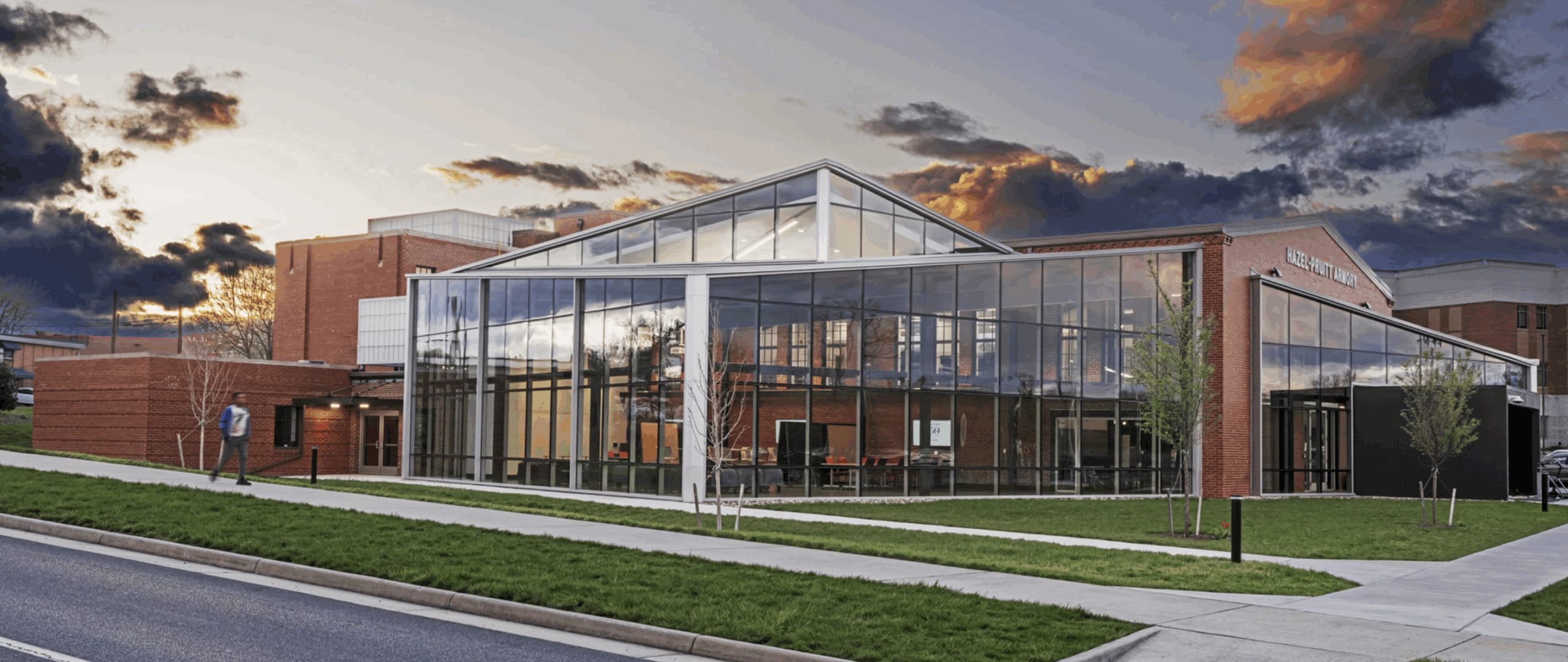
 WINCHESTER, Va. — We are delighted to announce that Learning By Design has selected THE HIVE at Shenandoah University (Hub for Innovators, Veterans and Entrepreneurs) as a GRAND PRIZE winner in the 2025 Architecture and Interior Design Awards of Excellence.
The project was designed by ESa, a nationally-regarded architecture firm based in Nashville.
A distinguished panel of architects and education facility professionals reviewed and debated the merits of all the awards submittals. The highest scoring submittals won top awards. These well-designed projects stood out for their novel design thinking, transparency, connectivity, safety, sustainability, great interiors, and sophistication.
Jury comments about this project included:
- “The narrative and images clearly convey a design deeply rooted in community needs. Adapting the existing building showcases sustainability and thoughtful inclusivity — lactation rooms, unisex toilets, and veteran services reflect careful programming. The project blends historic preservation with contemporary design, creating a striking identity that honors legacy while embracing innovation.”
- “This project demonstrates an exceptional blend of historic preservation and contemporary architectural expression. The striking contrast between the restored masonry and the angular glass addition creates a powerful identity rooted in both legacy and innovation. Adaptive reuse of a WWII-era armory into an immersive learning hub for modern disciplines is really interesting.”
- “The immersive labs, motion capture facilities, and e-gaming infrastructure reflect cutting-edge academic programming. The HIVE supports interdisciplinary, experiential learning, and digital fluency in ways that align with future-facing higher education models.”
About the Project
This adaptive-reuse project breathes new life into an historic military armory in Winchester, Virginia. Originally built in 1940, the building had served as a training ground for the National Guard from World War II until the early 1990s, while also hosting community events such as dances, wrestling matches, and performances — including a concert by (Winchester’s own) Patsy Cline.
The renovation began with the stabilization of the 18,000-square-foot building, including the safe removal of hazardous materials and ensuring a water-tight envelope through roof replacement, brick and stone repair, and the installation of historically appropriate replacement windows. By preserving the building, the adaptive reuse project honored its past while creating new, student-centered community spaces. The main gymnasium level now contains incubator and education spaces, such as an immersive learning technology lab, a motion capture lab, maker space, and a connection to the E-Sports arena.
In addition to the renovation, a significant new addition, the “Collaboratory,” was constructed and directly connected to the gymnasium. This signature element, with its glass form, delicately contrasted the masonry-heavy historic structure. Its modest scale respected the existing context, while its shifting roof planes celebrated the regional topography of the Shenandoah Valley and the Appalachian Mountains. The Collaboratory became the home of the Shenandoah Center for Immersive Learning (SCiL), supporting cross-disciplinary academic initiatives and serving as an intimate event space for up to 170 people.
The project aimed to provide Shenandoah University with an architectural landmark that honored Virginia’s Veterans and the Winchester community — past and present — while offering dedicated academic space for students. Through meticulous restoration and the sophisticated design of the modern Collaboratory, the HIVE now stands as a testament to Shenandoah’s enduring legacy, embodying its past, present, and future aspirations.
###
Photos: Eric Laignel for ESa